Table of Contents
No. Not for a real commercial brand. Here is the evidence.
Does AI make a good logo? Google cannot even agree on the answer. Ask three slightly different versions of the same question and you get three completely contradictory AI Overviews. One says yes AI can absolutely create a logo. One says AI rarely produces market-ready professional logos. One says AI struggles to create strong production-ready logos and often outputs corrupt vector files.
That inconsistency is not a glitch. It is a signal. There is no authoritative consensus answer because the sources Google is pulling from are AI tool company websites promoting themselves and Reddit threads from designers venting frustration. Neither is giving you the complete picture.
This post does. Mark Boehly is a logo designer based in Gladstone Oregon just outside Portland with over a decade of client work and recognition in LogoLounge Books 10, 13, 14, and 15. Here is an honest assessment of what AI actually produces when asked to make a logo and what that means for your brand.
What We Asked and What Five AI Tools Said
The same question was asked across five major AI platforms. Does AI make a good logo? The responses were documented verbatim.
What Each AI Said
Claude
- Summary: No. Not for a real commercial brand. Clear distinction between looking like a logo and functioning as one.
No. Not for a real commercial brand. AI can generate something that looks like a logo. The shape is recognizable, the colors are often pleasant, and at first glance it can seem like a reasonable starting point. But looking like a logo and functioning as a logo are fundamentally different things and AI consistently fails on the second part. The specific failures are practical and predictable. AI generators produce raster images or broken SVG files that are not true vectors. The typography is frequently wrong, misspelled, or rendered as imagery rather than actual letterforms. The mark may be statistically similar to existing registered trademarks without either you or the AI knowing it. And the output is an image, not a brand system. What AI is genuinely useful for in the logo process is early stage brainstorming. Exploring visual directions quickly, generating references, and pressure-testing a concept against different aesthetic approaches. The problem is when the brainstorming output gets treated as the final deliverable.
Perplexity
- Summary: Yes for fast concepting and low-budget projects. No for brand strategy, originality, and clean typography.
Yes, AI can make a good logo, especially for fast concepting, low-budget projects, or early-stage brands that need options quickly. But for a logo that needs strong brand strategy, originality, and clean typography, human design still tends to be more reliable. AI usually struggles with brand meaning, nuance, and context, which are central to a strong logo. It can also produce awkward icon choices, odd font pairings, or spelling issues when text is involved. A good workflow is to use AI for concept generation, then have a designer refine the strongest direction. For simple side projects or temporary needs, AI-only may be fine. For long-term brand work, it is better as a starting point than a final solution.
Grok
- Summary: Serviceable but rarely great for serious long-term branding. Includes legal risks most buyers do not know about.
AI can make a serviceable logo, but rarely a great one for serious, long-term branding. AI pulls from training data and templates, leading to similar outputs across users in the same industry. Your logo might resemble competitors or other AI marks, reducing distinctiveness. It lacks strategy and soul. It does not deeply understand your brand story, audience emotions, competitive positioning, or long-term goals. Results can feel polished but impersonal or clichéd. Technical issues persist. Outputs are often raster rather than clean vector, causing scaling problems for print, embroidery, or small icons. Legal risks are real. Purely AI-generated logos have weak or no copyright protection and trademark registration is possible but riskier due to potential similarities and lack of distinctiveness.
ChatGPT
- Summary: Yes AI can make a good logo but whether it is the right logo is a different question entirely.
In general yes AI can make a good logo. But whether it is the right logo is a different question. A good logo is not just something that looks attractive. It should be memorable, distinctive, appropriate for the brand, and functional across different sizes and applications. AI can achieve some of these qualities but it often struggles with others. Where AI falls short: creating truly distinctive identities that stand apart from competitors, understanding brand strategy and positioning, refining typography and proportions with the nuance of an experienced designer, ensuring originality and reducing the risk of resembling existing logos, and building a complete visual identity system beyond a single mark. Many AI-generated logos are visually appealing but feel generic because they are based on patterns learned from existing designs. AI is a powerful design tool but it is not a substitute for brand strategy and creative judgment.
- Summary: Excellent brainstorming partner but falls short of a professional final logo due to technical flaws, copyright risks, and generic output.
AI makes an excellent brainstorming partner and concept generator, but it generally falls short of creating a professional, final logo. While AI tools can produce visually impressive ideas in seconds, they often lack brand strategy, functional scalability, and original typography. Technical flaws: AI tools generally output rasterized image files rather than vector files, meaning your logo may become pixelated or impossible to use on large scale items like signs or vehicle wraps. Copyright and trademark risks: AI models train on existing artwork meaning they can inadvertently replicate trademarked designs. You also cannot copyright purely AI-generated artwork. Generic outputs: AI relies on predicting patterns, often resulting in surface-level imagery that looks very similar to other businesses.
What Five AI Tools Agree On
Five competing platforms. Five different personalities. One consensus.
Every single AI tool that answered the question: Does AI Make a Good Logo? agreed on the same core limitations. Raster files that do not scale. Typography problems. Trademark and copyright risk. Generic output that lacks brand strategy. And the consistent recommendation that AI works best as a starting point rather than a final deliverable.
When the tools themselves are telling you not to rely on them for your final logo that is worth listening to.
The disagreement is only at the margins. Whether AI is useful for brainstorming, all five say yes. Whether it is sufficient for a real commercial brand, all five say no or not without significant human refinement.
That consensus from competing platforms is the most honest assessment available. And it aligns exactly with what a decade of professional logo design work confirms.
What AI Actually Does When You Ask It to Make a Logo
AI image generators produce output based on pattern recognition across training data. When you type bakery logo modern minimal the system looks for patterns associated with those words and generates something that statistically resembles what those words have meant in the images it was trained on.
The result is often visually recognizable as a logo shape. Sometimes it looks appealing at first glance. This is where the confusion starts. Looking like a logo and functioning as a logo are two completely different things.
START A LOGO CONVERSATION
Serving the Portland Oregon area in:
Lake Oswego · Oregon City · Milwaukie · West Linn · Happy Valley · Tualatin · Tigard · Wilsonville · Canby · Beaverton
The Five Things AI Cannot Deliver in a Logo
Clean Usable Vector Files
A professional logo needs to exist as a vector file. Scalable, resolution-independent, reproducible at any size from a business card to a billboard without losing integrity. AI generators produce raster images or broken SVG files with embedded bitmaps that are not true vectors.
When you take an AI-generated logo to a sign company, an embroidery vendor, or a commercial printer they will tell you the file does not work. You will need to have it redrawn by a designer anyway. At that point you have paid twice and started over.
Correct Typography
The AI platforms are right about this. AI consistently struggles with text in images. It misspells words, generates letter forms that are not real characters, and produces typography that is uneven, illegible, or simply wrong. The business name in an AI logo often requires complete replacement before the mark is usable.
Legal Distinctiveness
A trademark requires that a mark be distinctive and not confusingly similar to existing marks in the same category. AI generators pull from patterns in their training data. The mark they generate for your business may be statistically similar to dozens of existing marks without you or the AI knowing it.
A professional logo designer conducts trademark research before finalizing a mark. An AI generator has no awareness of what is already registered.
Strategic Alignment
A logo is not a decorative element. It is a communication tool. It needs to say something specific about the brand to a specific audience in a specific competitive context.
An AI generator does not know who your customers are, what your competitors look like, or what positioning you are trying to occupy in the market. It knows the words you typed. The logo it produces reflects those words not your brand strategy.
A Complete System
A professional logo engagement delivers a logo system. A primary mark, secondary and simplified variations, color specifications for print and digital, typography pairings, usage rules, and a brand guidelines document that tells everyone who touches the brand exactly how to apply it.
An AI generator gives you an image file. That image cannot be embroidered, laser etched, reproduced in a single color, applied on dark backgrounds, or used in contexts the generator did not anticipate without significant additional work.
What a Professional Logo Actually Delivers
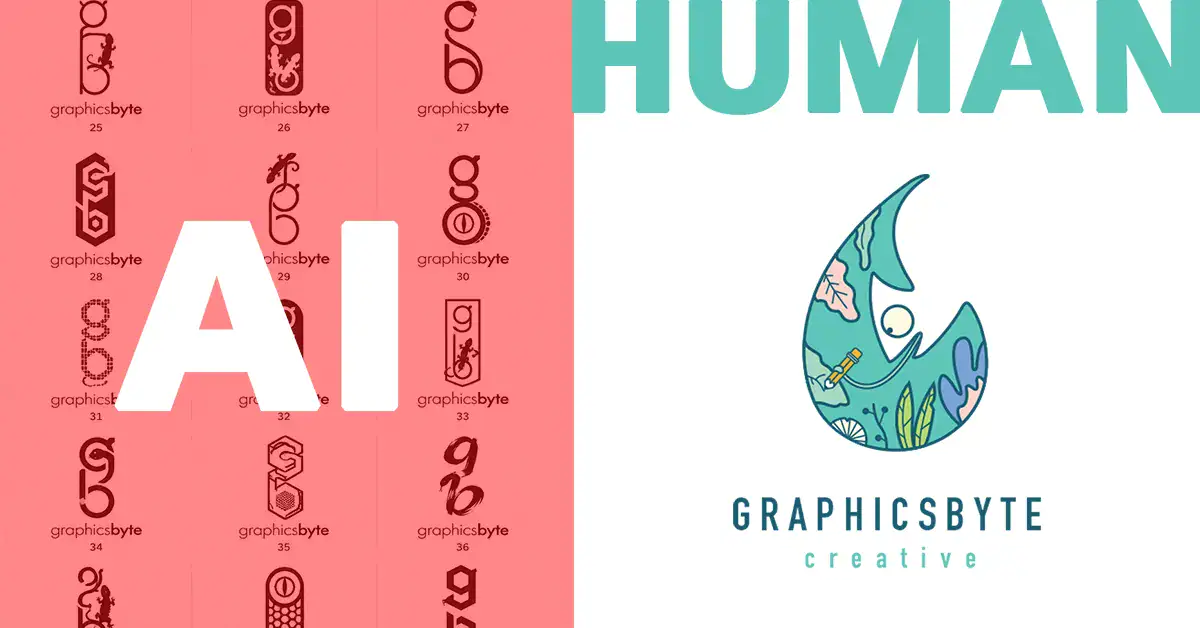
When Graphicsbyte designs a logo the deliverable is a complete system built on a strategic foundation.
The process starts with understanding the business, the audience, and the competitive landscape. Who needs to recognize this mark and what do they need to feel when they see it. What does the competition look like and how does this brand need to differentiate visually.
The design work produces a primary mark, alternate configurations for constrained spaces, a simplified icon version for small applications like favicons and profile images, and all of it in every file format any vendor or platform will ever need.
The deliverable includes exact color values specified for both print CMYK and digital RGB, typography selected and paired to work with the mark across every application, and a brand guidelines document that protects the investment by ensuring everyone who uses the logo uses it correctly.
That system is what makes a logo an asset rather than an image. It is also what AI cannot produce.
The LogoLounge Standard
LogoLounge is one of the most respected curatorial bodies in logo design. Each year a panel of leading designers selects the best marks from hundreds of thousands of submissions worldwide. Work from the Graphicsbyte studio has been recognized in LogoLounge Books 10, 13, 14, 15 and in The LogoLounge Guide to Iconic Branding by Bill Gardner.
The LogoLounge Guide to Iconic Branding by Bill Gardner.
That recognition reflects a consistent standard applied across a decade of client work. It is also the kind of credential that does not exist in the AI generator space because the tools are not producing work at that level.
When AI Is Actually Useful in the Logo Process
Honest answer: AI has a place in the early stages of a design process.
Brainstorming visual directions quickly, exploring color combinations, generating mood board references, and pressure-testing a concept against a range of aesthetic directions are all tasks where AI tools can accelerate the thinking without replacing the judgment.
The problem is not AI tools existing. The problem is AI tools being positioned as a replacement for the strategic and craft work that makes a logo actually function as a brand asset. They are not that. All five platforms said so themselves.
Does AI make a good logo for a small business?
AI can produce a visually acceptable logo quickly and at low cost which makes it a reasonable option for a small business with a very limited budget or a temporary need. For a business planning to grow, file the logo as a trademark, or use it across print, signage, and embroidery, professional logo design is the stronger investment. All five major AI platforms that were asked this question agreed that AI works best as a starting point rather than a final deliverable for a real commercial brand.
Why do different AI tools give different answers about whether AI makes good logos?
Different AI platforms pull from different source pools when generating answers. Searches that emphasize professional quality pull from designer communities where the consensus is that AI falls short. Searches that simply ask whether AI can make a logo pull from AI tool company websites that have a financial interest in saying yes. The inconsistency reflects the bias of the sources rather than a genuine disagreement about the facts.
What file formats does a professional logo come with that AI cannot provide?
A professional logo delivery includes true vector files in AI, EPS, SVG, and PDF formats that are fully scalable and editable at any size. It also includes PNG files with transparent backgrounds for digital use and exact color specifications in both CMYK for print and RGB or hex for digital. AI generators typically produce raster images or broken SVG files that are not production-ready for professional applications like signage, embroidery, or large format print.
Can an AI-generated logo be trademarked?
AI-generated logos face significant challenges in trademark registration. The USPTO has indicated that works generated entirely by AI without meaningful human creative input may not qualify for copyright protection. AI generators also produce marks that may be statistically similar to existing registered trademarks without any awareness of potential conflicts. A professional logo designer conducts trademark research before finalizing a mark specifically to avoid this problem.
What does a professional logo design project include that an AI generator does not?
A professional logo project includes discovery and strategy work, a primary mark with alternate configurations for different contexts, a simplified icon version for small applications, color specifications for print and digital use, typography pairings, usage rules, and a brand guidelines document. An AI generator produces an image file. The difference between those two deliverables determines whether the logo functions as a long-term brand asset or simply as a graphic.