Table of Contents
The terminology has shifted and the reason matters
Walk into a design school today and you are more likely to find a communication design program than a graphic design program. The discipline has not changed fundamentally but the name reflects a deliberate repositioning toward outcomes rather than craft.
For businesses hiring design help that shift creates a genuine question. Communication design vs graphic design, what is the actual difference, does it matter for the work you need done, and how do you know which one to look for when evaluating agencies or studios?
This post answers those questions directly.
What Graphic Design Is
Graphic design is the practice of combining visual elements including type, imagery, color, and layout to create communication. It is a craft discipline with a long history and a well-defined body of skills. A graphic designer works with the tools and principles of visual composition to produce materials that serve a communication purpose.
Historically graphic design was associated primarily with print production. Posters, books, magazines, packaging, and advertising were the primary outputs. The digital era expanded the canvas to include screen-based design but the core discipline remained focused on the visual craft.
Graphic design at its best is intentional, skilled, and serves the communication goal it was assigned. The limitation of graphic design as a frame is that it describes the method rather than the outcome. It tells you what the designer does but not what the work is supposed to achieve.
What Communication Design Is
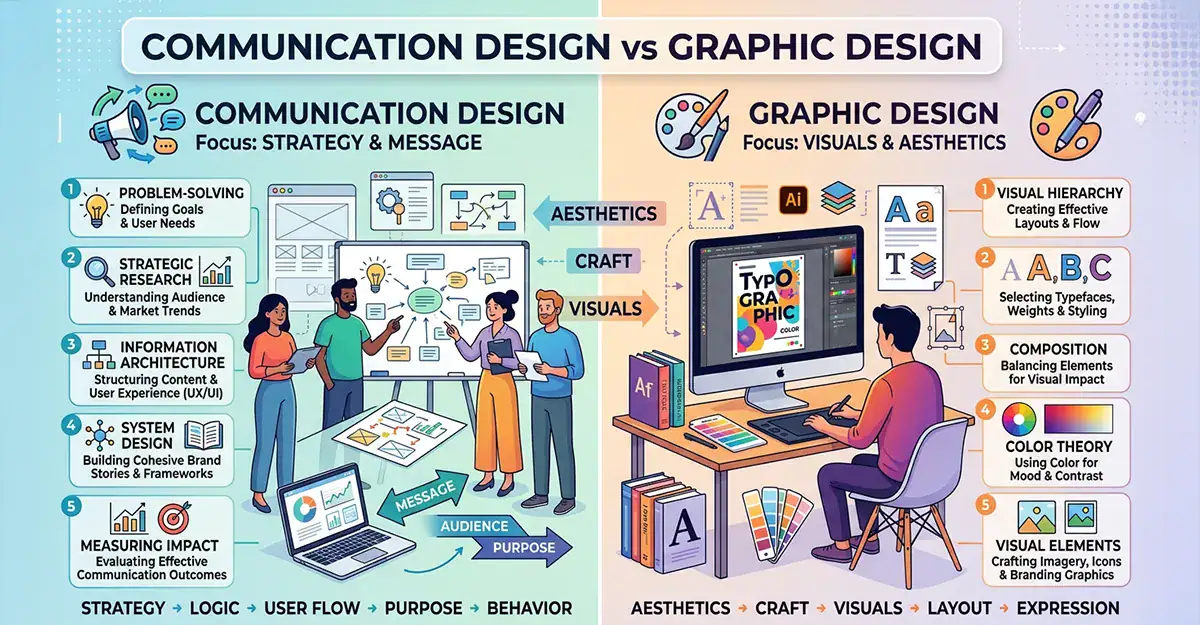
Communication design encompasses graphic design and extends it with a strategic layer focused on outcomes. A communication designer is concerned not just with how something looks but with whether it achieves its intended effect on its intended audience.
The questions a communication designer asks go beyond the visual. Who is the audience and what do they already know? What do they need to understand or feel after encountering this piece? What action should follow? What barriers exist between the current state and the desired outcome and how does the design address them?
That outcome-focused thinking shapes every visual decision. The layout is not just aesthetically considered. It is structured to direct attention in a specific sequence. The typography is not just well-chosen. It is selected and set to communicate a specific personality and level of authority. The color palette is not just harmonious. It is calibrated to the emotional register the audience needs to experience in order to trust and act.
Learn About Our Cannabis Branding Experiences
Where They Overlap
The overlap between communication design and graphic design is significant. Most of the daily work looks the same from the outside. Both disciplines produce logos, brand identities, websites, packaging, print materials, and digital assets. Both require mastery of typography, color, layout, and visual hierarchy.
A skilled graphic designer with strategic instincts is doing communication design whether or not they use that label. A communication designer without strong visual craft skills is doing strategy without the execution quality to make it land.
The distinction is not about the outputs. It is about the thinking that drives the decisions behind them.
Where They Diverge
The divergence becomes most visible in how each discipline approaches a brief.
A graphic design approach starts with the visual problem. What should this look like? What style fits the brand? What layout works for this format?
A communication design approach starts with the audience and the outcome. Who needs to receive this message? What do they currently think or feel? What do we need them to think, feel, or do after encountering this? What visual decisions will create that shift?
For straightforward production work the difference is minimal. A business card needs to look professional and include the right information. Either approach gets there.
For complex brand problems, conversion-focused websites, packaging that needs to compete at shelf, or campaigns that need to shift audience perception, the communication design approach produces meaningfully better outcomes because the visual decisions are grounded in a clear understanding of what the work needs to accomplish.
What This Means When Hiring
When evaluating graphic design agencies or studios the communication design vs graphic design distinction gives you a useful filter.
Ask how they approach a new project. A graphic design approach leads with questions about aesthetic preferences, brand style, and visual references. A communication design approach leads with questions about the audience, the desired outcome, the competitive context, and what success looks like.
Neither approach is wrong for every project. But for businesses that need their design work to produce measurable outcomes, attract specific clients, convert visitors, or shift perception, the communication design approach is the more valuable one.
The practical implication for graphic designer branding work specifically is significant. A logo or brand identity developed through a communication design lens is built around what the brand needs to communicate to whom and why, not just what looks good or what the client finds appealing. That foundation makes every subsequent design decision more coherent and more defensible.
Which One Does Your Business Need
For most businesses the honest answer is both and the distinction is less important than finding a designer or studio that thinks strategically and executes with craft.
What is worth looking for is evidence that the designer you are considering thinks about outcomes rather than just outputs. Do they ask about your audience before they ask about your aesthetic preferences? Do they talk about what the work needs to do rather than just what it will look like? Do their case studies describe results rather than just showing finished work?
Those signals tell you more about whether a designer practices communication design than whatever label they use to describe themselves.
What is the main difference between communication design and graphic design?
Graphic design focuses on the visual craft of combining type, imagery, color, and layout. Communication design encompasses those skills and adds a strategic layer focused on outcomes, whether the design achieves its intended effect on its intended audience. The outputs often look similar. The thinking behind them is different.
Is communication design better than graphic design?
Neither is inherently better. Communication design is a more useful frame for complex brand and marketing problems where measurable outcomes matter. Graphic design as a discipline contains all the craft skills needed for excellent work. The distinction is about approach and scope rather than quality. A skilled practitioner of either discipline who thinks strategically and executes with craft is more valuable than someone who claims one label but lacks the thinking behind it.
Do graphic design agencies practice communication design?
Many do without necessarily using that label. The best graphic design agencies approach every project with strategic thinking about audience and outcome alongside the visual craft. The rise of communication design as a discipline name reflects the industry’s broader move toward outcome-focused work rather than a fundamental change in what the best designers have always done.
Should I hire a communication designer or a graphic designer for my brand?
Look for evidence of strategic thinking rather than focusing on the label. Ask how they approach a new brief. If they lead with questions about your audience, your goals, and what success looks like before asking about visual preferences, they are practicing communication design regardless of what they call themselves. That thinking is what produces brand work that performs rather than just impresses.
How does visual communication design fit into this comparison?
Visual communication design is a subset of communication design focused specifically on conveying information through imagery, illustration, data visualization, and iconography. It sits within the broader communication design discipline the same way typography or layout does. All three terms, graphic design, communication design, and visual communication design, describe overlapping areas of the same broader field of practice.