Table of Contents
Your brand sounds like something whether you designed it that way or not
Every email, every social post, every page of website copy, every proposal, every out-of-office message. All of it communicates something about how the business thinks and how it wants to be perceived. The question is whether that communication was intentional or accidental.
Brand voice is the intentional version. It is the defined personality and communication style a business uses consistently across every written touchpoint. When it is working, nobody notices it explicitly. They just feel like they know the business. They recognize it before they see the logo. They trust it faster because it sounds like itself every time.
When it is not working, the brand sounds like whoever wrote the last piece of copy. Different on the website than in the proposal. Different on Instagram than in the email newsletter. Inconsistent in ways that are harder to pinpoint than visual inconsistency, but equally damaging to the trust that drives buying decisions.
What Brand Voice Actually Is
Brand voice is the consistent personality behind every piece of communication a business produces. It is not the words themselves but the character those words express. Direct or narrative. Formal or conversational. Technical or accessible. Warm or authoritative. Playful or serious.
Most brands are a combination of several qualities rather than a single dimension. A brand voice definition articulates those qualities specifically enough that two different people writing for the same brand produce copy that sounds like it came from the same place.
That specificity is what separates a useful brand voice definition from a generic one. Saying a brand is professional, friendly, and helpful describes almost every business that has ever existed. Saying a brand is direct without being blunt, knowledgeable without being condescending, and occasionally dry in its humor is a definition specific enough to actually guide writing decisions.
Brand Voice vs. Brand Tone
These two terms get used interchangeably but they refer to different things and the distinction matters in practice.
Brand voice is consistent. It is the stable personality behind all communication and it does not change based on context or audience. The character of the brand stays the same whether the business is writing a homepage headline or responding to a customer complaint.
Brand tone is variable. It is the emotional register of a specific piece of communication and it adjusts based on context. The same brand with the same voice uses a different tone in a celebration post than in a response to a service issue. Warmer and more energetic in one situation. More measured and empathetic in the other. The voice stays constant. The tone modulates within it.
Understanding that distinction is what allows a brand to be consistent without being robotic. The personality stays the same. The emotional delivery responds to the situation.
View the Cup of Tea, Clackamas OR Case Study
Why Brand Voice Matters as Much as Visual Identity
Most brand investment goes into visual identity. Logo, color, typography, layout. Those elements are visible and tangible and the results of getting them right are immediately apparent.
Brand voice is less visible but equally powerful. It operates in every piece of written communication the business produces and most businesses produce far more written communication than visual communication on any given day. Emails, social posts, proposals, follow-ups, website updates, blog content, text messages, invoices. All of it either reinforces the brand or dilutes it.
A strong visual identity paired with inconsistent copy produces a brand that looks polished and sounds assembled. The visual credibility gets undermined by written communication that does not match it. Clients and customers may not be able to articulate what feels off but they feel it.
Brand voice and visual identity working together is what produces the kind of brand recognition that compounds over time. Every consistent touchpoint adds to the same impression rather than pulling in different directions.
What a Brand Voice Definition Includes
A useful brand voice definition covers several interconnected elements.
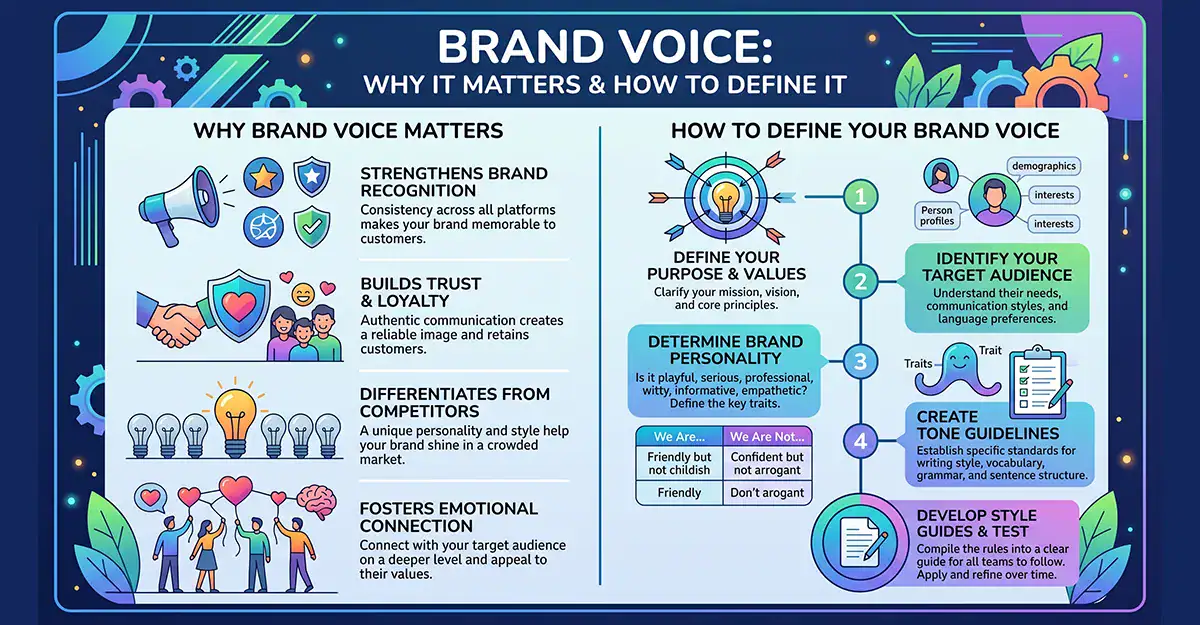
Personality traits: Two to four specific adjectives that describe the brand’s character with enough precision to distinguish it from competitors. Each trait should be accompanied by a brief explanation of what it means in practice and what it does not mean. Direct means concise and clear. It does not mean blunt or dismissive.
Voice characteristics: How the brand communicates structurally. Sentence length, vocabulary level, use of technical language, use of humor, use of first person versus second person. These are the observable qualities that make copy identifiable as coming from a specific brand.
What the brand sounds like and what it does not: Positive and negative examples are often more useful than abstract descriptions. This is how the brand would say something. This is how it would not.
Channel guidance: How the voice adapts across different contexts without losing its core character. The same brand voice shows up differently in a LinkedIn post than in a text message follow-up but both are recognizably the same brand.
Developing Brand Voice
Brand voice development starts with understanding the brand’s positioning, audience, and values. The voice needs to resonate with the people the brand is trying to reach and reflect what the brand actually stands for rather than what sounds good in a workshop.
The most useful input is existing communication. Emails that felt right, copy that got strong responses, moments where the brand sounded like itself without trying. Those examples are more revealing than abstract personality exercises because they show the voice that already exists rather than the voice someone imagined.
From there the work is articulation and codification. Naming what is already working, making it specific enough to be intentional and repeatable, and documenting it in a form that can guide future writing whether the author is the founder or a contractor hired two years from now.
Brand Voice at Graphicsbyte
Brand voice development is part of the Tier 1 strategy work at Graphicsbyte. It sits alongside positioning and brand strategy as foundational work that shapes everything built on top of it including the visual identity and the website.
The most common scenario is a business that has an intuitive sense of its own voice but has never articulated it clearly enough to apply it consistently. The work in that situation is discovery and documentation rather than invention. The voice already exists. It just needs to be named precisely enough to be used intentionally.
What is brand voice and why does it matter?
Brand voice is the consistent personality and communication style a business uses across every written touchpoint. It matters because every piece of written communication either reinforces the brand or dilutes it. A brand that sounds like itself consistently builds recognition and trust faster than one where the voice changes depending on who wrote the last piece of copy. Visual identity and brand voice working together produce the kind of compounding brand recognition that drives buying decisions over time.
What is the difference between brand voice and brand tone?
Brand voice is consistent. It is the stable personality behind all communication and does not change based on context. Brand tone is variable. It is the emotional register of a specific piece of communication and adjusts based on the situation. The same brand uses a warmer more energetic tone in a celebration post and a more measured empathetic tone in a response to a service issue. The voice stays constant. The tone modulates within it.
How do you define a brand voice?
Brand voice definition starts with understanding the brand’s positioning, audience, and existing communication. The most useful input is examples of communication that already felt right, emails that got strong responses, copy that resonated with the right people. From that starting point the work is articulation and codification, naming the qualities that are already working and making them specific enough to be intentional and repeatable across every future piece of communication.
Can a small business benefit from defining its brand voice?
Yes and arguably more than larger businesses. A small business where the founder writes most of the communication has an inherent voice consistency because one person is doing the writing. Defining that voice explicitly protects it as the business grows and other people begin writing on behalf of the brand. It also makes the founder’s communication more intentional rather than relying on instinct that may be difficult to transfer.
How does brand voice relate to brand strategy?
Brand voice is one of the outputs of brand strategy. The strategy defines who the brand is, who it serves, and what it stands for. The voice is how that identity expresses itself in written communication. A brand voice developed without a strategic foundation may sound interesting but not connect with the right audience or reinforce the right positioning. Strategy comes first. Voice is built on top of it.